



Every human being enters this world as a creature of need.Every human being enters this world as a creature of need.
Before language. Before thought. Before identity. The newborn organism arrives as a living petition — for nourishment, safety, warmth, touch, protection, rest, tenderness, and love. When these primordial needs are met, life opens like a flower finding light. When they are denied, delayed, neglected, or violated, something far deeper than sadness occurs — the entire organism begins to register pain. This is where Broken Heart Syndrome is truly born. Modern medicine knows it as a stress-induced condition of the heart — triggered by acute emotional or physical shock. And that is true. But medicine has only seen the lightning strike. It has not yet asked about the storm. What happens when stress is not a single event — but the very atmosphere into which a child is conceived, carried, born, and raised? What happens when heartbreak is not a wound suffered later in life — but the climate of the womb itself? The chronic tension coiled in the mother's body. The chemistry of her fear, her exhaustion, her sorrow, her deprivation, her loneliness — absorbed by an unborn child who has no words for what it is already feeling, no walls yet built to keep it out? This is not metaphor. This is the origin.


The fetus does not grow in abstraction. It grows inside the biological weather of its mother. Her rest, her nutrition, her emotional state, her hormonal balance, her safety, her sense of being held and supported by the world — these are not luxuries. They are not comforts added after the essential work is done. They are the first architecture. The original blueprint. The living environment inside which a human being is assembled, cell by cell, day by day. Science confirms what the body has always known: maternal stress reaches the unborn child. It shapes fetal development. It leaves its signature on long-term human health. The unborn child is not sealed off from the mother's condition — the unborn child is formed within it, woven from it, made of it. So, ask yourself this: What becomes of a child conceived inside a mother who is herself living in heartbreak? A mother who is unsupported. Overburdened. Emotionally wounded and physically depleted. A female imprisoned inside a world — a patriarchal world — that denies her the rest, the reverence, and the protection she is owed as the very vessel of human life? Her unmet needs do not disappear. They do not stay quietly inside her. They become, in the most literal biological sense, part of the earliest environment of her unborn child. The child's cells are not formed in peace. Not in nourishment. Not in the serene kingdom they deserved by right of existence. They are formed in a field of stress. Of tension. Of survival. And the body remembers everything it was built inside of.

Dr. Frédérick Leboyer did not merely change how babies are born. He changed how humanity sees what birth actually is. This French obstetrician — whose landmark work, Birth Without Violence, shook the foundations of modern medicine — issued a demand so simple it should never have needed saying: treat the newborn as a sentient being. Not as a biological object to be extracted, measured, and handled with clinical efficiency. But as a human soul crossing the most vulnerable threshold of existence — arriving raw, open, feeling everything. His vision of birth was one of reverence. A relaxed mother. Soft light. Quiet. Warmth. A passage from womb to world made sacred by tenderness and care. His message was not merely obstetrical It was civilizational. He was asking humanity to understand that the first minutes of life can become either the first wound — or the first blessing. That the newborn does not arrive as a blank creature immune to shock. The newborn arrives as a being already capable of suffering. And Leboyer's warning about what we had been doing to them was severe, unforgettable, and shattering: "Hell is… at the beginning." He was not speaking in metaphor. He was speaking of the infant hurled from the warm dark of the womb into blinding lights, cold air, sharp noise, rough hands, and the sudden violent absence of the mother's body. He was speaking of medical indifference dressed as medical procedure. His central revelation was this: the manner of birth matters — because the newborn's first encounter with the world is not forgotten. Not by the mind. Not yet. By the body. Always.

Dr. Arthur Janov arrived with a revelation that the world was not ready to hear. Neurosis does not begin as a thought. It does not begin as a belief, a pattern, or a habit of mind. It begins as unfelt pain. Janov — founder of Primal Therapy and author of The Primal Scream — spent his life tracing the hidden architecture of human suffering back to its true origin: the early unmet need. The childhood wound absorbed in silence. The unbearable pain that had nowhere to go and no one to receive it — and so went inward, down, deep into the body, where it did not die. It waited. Inside the nervous system. Patient. Wordless. Alive. Because the child does not simply get over unbearable pain. The child cannot. The child survives it the only way survival is possible: by repressing it. By building walls around it. By learning, unconsciously and brilliantly, to function as though the wound does not exist. And then that child grows up. And the adult walks through the world carrying symptoms they cannot explain — rage without a clear source, depression without a name, anxiety that arrives without warning, compulsions they cannot stop, emotional fragmentation that makes intimacy feel like danger. They do not know they are still obeying the survival logic of a child in pain. This was Janov's shattering gift to human understanding: The wounded adult is the wounded child — still crying, beneath the mask of maturity. He gave language to the buried scream. The pain that could not be felt when it happened. The need that could not be met when it mattered. The heartbreak that was never mourned — and so became structure. Became symptom. Became destiny.

The Broken Heart Syndrome of humanity does not begin where most people think it begins. Not with the lover who betrays. Not with the marriage that collapses. Not with the dream that dies or the world that turns its back. Those are later wounds. Later chapters. Later echoes of something far older. The first heartbreak may begin before the first breath. In the womb of a mother the world failed to support. In the violence of a birth stripped of tenderness. In the silence that answered the infant's cry. In the absence of touch when touch was oxygen. In the lack of protection when protection was everything. In the emotional starvation that forced the developing human being to do the most tragic thing a human being can do — split from its own pain in order to survive. Humanity is not suffering because the heart is weak. Humanity is suffering because the heart was wounded from the very beginning — and then commanded to be silent about it. Broken Heart Syndrome, in this deeper medical, psychological, and existential truth, is not merely a disease of the heart. It is the biography of unmet human need, written into the body in a language older than words. It is the mother's sorrow transmitted through the womb. It is the shock of birth when birth is not gentle. It is the infant's unanswered cry, echoing forward through decades. It is the child's pain with nowhere to go — and nowhere to go it does not mean gone. It means buried. It means waiting. It means one day returning as the adult's rage, addiction, numbness, cruelty, depression, vengeance, and devastating loneliness. This is where it all begins. Not in evil. Not in weakness. Not in moral failure. In unmet need. In unfelt pain. In the first broken heart of life.

And that hell does not end at birth. It continues. Through infancy. Through childhood. Through the bewildering years of adolescence. Because the parents waiting on the other side of that birth are themselves broken. They, too, were once that unanswered infant. That unprotected child. That teenager whose pain was never witnessed, whose needs were never truly met. They carry their own Broken Heart Syndrome — unexamined, unnamed, unhealed — into the most sacred responsibility a human being can hold. And so, they do not parent the child standing before them. They parent the child they once were. Unconsciously. Desperately. They reach toward their children not to fill the child's emptiness, but to finally fill their own. They shape, mold, demand, and define their children — not from cruelty, but from a wound so old and so deep they cannot see it. They need their children to become what they need them to become, so that somewhere in the becoming, their own broken heart might finally feel mended. It never does. And so, the cycle does not break. It deepens. The wounded parent raises the wounded child. The wounded child becomes the wounded parent. Generation after generation, the inheritance passes — not through blood alone, but through unmet need, unspoken pain, and the particular violence of love that has never learned how to love without taking. Every child, in this way, arrives into the world already carrying what the world has never healed. But understand this — and understand it fully: Broken Heart Syndrome is not merely sorrow. It is not merely sadness, or struggle, or a quiet wound that one learns to live around. Left unhealed, it becomes something far darker. It is the root seed from which the most sinister human personas grow. Personas so consumed by their own unacknowledged pain that they become engines of destruction — tearing through relationships, through families, through entire lives — leaving devastation in every direction. Including their own.

Every wounded heart carries a hidden flame. A flame of vendetta. A burning, ancient, furious desire to avenge the pain — to make the one who broke you feel what you have felt, to believe, with every fiber of your being, that if you can only make them suffer enough, the scales will finally balance. Humanity is tragically, devastatingly wrong about this. Revenge does not mend the broken heart. It does not even the score. It does not close the wound or silence the buried scream. Revenge only drives the blade deeper — multiplying the suffering, extending the prison, and transforming the victim into something they never intended to become: a mirror of the very cruelty that broke them. The vindictive heart believes it is digging one grave. For the one who caused the pain. For the one who deserves to fall. But in truth, it digs two. One for the other. One for itself. Because every act of revenge raises the stakes for greater revenge. Every blow answered demands another. Every chain of destruction forged in the name of justice pulls both sides further from healing, further from freedom, further from the life the broken heart was always meant to live. The broken heart is not healed by punishment. It is healed only when its buried pain is finally felt — fully, courageously, without flinching — and then released. And then transformed. This is the eternal truth humanity must reckon with: Revenge is not justice. Revenge is self-destruction wearing the mask of justice. And when the wounded human cannot confront the true source of their pain — when the original wound is too buried, too old, too frightening to face — the rage does not disappear. It finds another target. A powerless one. A voiceless one. One that cannot fight back. The innocent animal. Every act of cruelty committed by a human against an animal is not the act of a monster born without feeling. It is the act of a broken human heart displacing its unprocessed pain onto a being incapable of defending itself. It is rage that could not reach its true source. Humiliation that had no voice. Heartbreak and helplessness so long denied that they curdled into violence — and sought the weakest available body to receive them. This is not strength. This is not dominance. This is not power. This is a wounded soul committing its most cowardly act. Animal cruelty is the revenge of the broken upon the innocent. It is pain attempting to reproduce itself in a smaller, softer body. It is the unhealed human heart forcing another living creature to carry the suffering it refuses to feel. And therefore, every act of cruelty inflicted upon an animal is not merely cruelty against that animal. It is a public confession. Of an inner wound so deep, so long ignored, so thoroughly poisoned by time — that it has begun to bleed outward onto the world's most defenseless lives.

Every animal confined in a cage is a verdict. Not upon the animal. Upon us. The creature born to roam beneath an open sky, now pacing four walls of concrete and steel. The being created for wildness, for wind, for the vast indifferent dignity of nature — chained to a post, displayed behind glass, broken into servitude for the entertainment, convenience, and comfort of the species that calls itself civilized. This is not greatness. This is not dominion in any sacred sense. This is sickness. Dressed in the language of progress. A humanity that has never healed its own buried pain does not know how to encounter the wild without needing to own it. It cannot stand before something free without reaching for a chain. It cannot witness something untamed without building a cage around it — because something untamed and free is a mirror, and a broken heart cannot bear what it sees in that mirror. And so, it captures what should be free. It controls what should be wild. It imprisons what should breathe under the open sky. Not from strength. From wound. Every chained animal is an indictment of what humanity has refused to heal in itself. Every caged creature is a confession extracted not by courts, but by the speechless testimony of suffering. Every zoo, every chain, every creature stripped of its nature and its freedom holds a mirror before the human soul — and in that mirror is not the face of a conqueror. It is the face of a species still bleeding from its first broken heart. Animal cruelty — in all its forms, overt and institutional, individual and civilizational — is not only a crime against the voiceless. It is the most damning evidence of humanity's own unhealed wound. A wound so old, so deep, so systematically denied — that it has metastasized into domination over every defenseless life within reach. The cage we build for the animal— is the cage we have never found the courage to unlock within ourselves.


The only path to ending animal cruelty is to mend the broken hearts of humanity. Because the broken-hearted human does not reserve its cruelty for animals alone. It turns that same unhealed wound upon itself — through addiction, through self-destruction, through a life lived in unconscious devotion to pain. The Addictions of the Broken Heart What else can a human being do when the heart remains wounded, unhealed, and silently crying beneath the entire surface of a life? A broken heart is not a passing emotion. It is not grief that runs its course and releases. It is a living splinter lodged deep inside the soul — aching when untouched, burning when pressed, distorting the mind, poisoning the emotions, commanding the body to seek relief by any means it can find. And the broken heart, in its desperation, does not first seek wisdom. It seeks compensation. It seeks to even the score — with life, with love, with the world, with the one who inflicted the original wound, with any weaker being that can be made to absorb what it cannot bear to carry alone. It seeks revenge. But revenge never mends the broken heart. It never could. It offers only the momentary illusion of power — a flash of satisfaction that dims before it is even fully felt — and leaves behind a wound deeper than the one it claimed to answer. And when revenge fails, as it always must, the broken heart does not stop searching. It descends. It reaches for the next false medicine. The one that promises relief without requiring healing. The one that numbs without curing. The one that fills the void for an hour, a night, a season — and then empties it again, wider than before. It reaches for addiction. The form is almost beside the point. It may arrive as drugs. As alcohol. As gambling. As compulsive sexuality, pornography, or the hollow conquest of one body after another in search of a feeling that never quite arrives. It may wear the face of food consumed in secret, of money hoarded beyond all need, of control exercised over others to silence the chaos within. It may come as rage indulged like a drug. As domination mistaken for dignity. As humiliation inflicted to feel, for one violent moment, that power belongs to you. The substance changes. The wound does not.
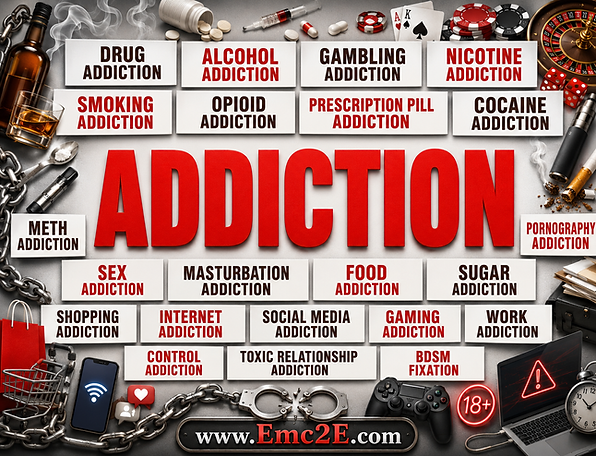
Addiction is the language of the broken heart.
Humanity does not become addicted because it is weak. Humanity becomes addicted because its heart remains unmended. And therefore, to mend humanity's broken hearts is to cure the fountainhead from which all addictions arise. And among the darkest expressions of this broken-heart hunger is the BDSM Master-slave relationship — where the wounded human attempts to transform inner powerlessness into outer domination, or inner shame into outer submission. The Master commands because somewhere within, it once felt utterly helpless. The slave surrenders because somewhere within, it has ceased to believe it deserves sovereign love. Both roles may appear chosen. Consensual. Freely entered. But beneath the ritual, the costumes, the commands, and the obedience — beneath all of it — the deeper truth is unmistakable: A broken heart is attempting to reenact its wound instead of heal it. This is not love. This is not liberation. This is not the natural hunger of the human heart finally satisfied. This is the theater of unresolved pain. Performed with conviction. Mistaken for freedom. Every addiction is the broken heart's attempt to anesthetize itself. Every addiction promises relief — and delivers bondage. Every addiction whispers of freedom — and builds a prison. Every addiction offers pleasure — and extracts payment in emotional illness, mental disorder, physical deterioration, spiritual emptiness, and the slow, quiet ruin of financial life. And soon — inevitably, cruelly — the addiction becomes more destructive than the original heartbreak that summoned it. The broken heart first suffers pain. Then addiction multiplies that pain into dependency, compulsion, secrecy, shame, self-betrayal, and collapse. The human being becomes divided against itself. Its brain no longer thinks naturally. Its emotions no longer feel naturally. Its body no longer functions naturally. Its choices no longer serve life — no longer serve love, health, family, prosperity, or peace. And this — this precise and terrible unraveling — is how Broken Heart Syndrome gives birth to Unnatural Brain Physiology. Once the brain becomes unnatural, everything it touches becomes unnatural. It thinks unnaturally. It chooses unnaturally. It desires unnaturally. It builds a life that grows, year by year, poorer in health. Poorer in love. Poorer in dignity. Poorer in morality. Poorer in peace. Poorer in wealth. Not because the person is cursed. Not because they are evil. Not because fate has singled them out for suffering. But because an unhealed heart, left long enough to its own pain, rewires the very instrument through which a human being navigates existence. This truth is not hidden in obscure texts or locked inside laboratories. It is written across the entire history of mankind — in every civilization that rose on violence and fell on its own excess, in every life that began in promise and ended in ruin, in every human being who wanted more than anything to be free — and could not understand why freedom kept slipping through their hands.

Look at the evidence. The wars of nations. The cruelty of homes. The exploitation of bodies. The marketplace of addictions. The domination of the weak by the powerful. The collapse of families. The sickness of relationships. The endless, insatiable human hunger for escape. All of it testifies to one undeniable fact: Humanity's Broken Heart Syndrome has not been healed. It has merely changed disguises. Look at the evidence. The wars of nations. The cruelty of homes. The exploitation of bodies. The marketplace of addictions. The domination of the weak by the powerful. The collapse of families. The sickness of relationships. The endless, insatiable human hunger for escape. All of it testifies to one undeniable fact: Humanity's Broken Heart Syndrome has not been healed. It has merely changed disguises. And until the broken heart is restored to its natural state, humanity will continue — generation after generation, civilization after civilization — mistaking revenge for justice. Addiction for relief. Domination for power. Submission for love. Self-destruction for freedom. If you could sit on another planet and observe the human story from its beginning — watch the full sweep of human history unfold across millennia — what would you see? You would see a species that is the most predatory enemy of its own kind. No creature on earth has murdered, enslaved, tortured, exploited, and systematically destroyed others of its own species with the consistency and creativity that humanity has. The history of human civilization is largely the history of what broken hearts do when they are given armies, borders, and the authority to call their violence righteous. Even the sacred texts — the very books humanity turned to for solace, for meaning, for the face of God — are saturated with violence. With vengeance. With a God who destroys, punishes, and wages war alongside chosen people against unchosen ones. With a Devil who tempts, corrupts, and embodies everything the human heart most fears about itself. But God and Devil are not external beings. They are internal states.

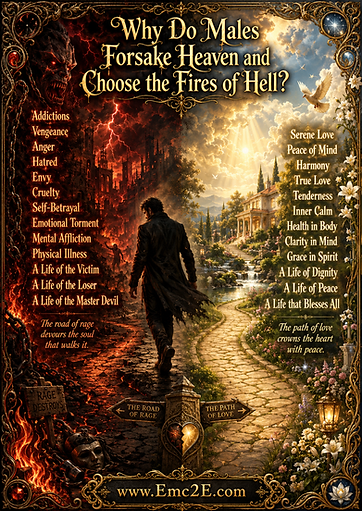
God is what nature built into the human being at the beginning — the capacity for love, for tenderness, for connection, for creativity, for reverence, for life. The Devil is what Broken Heart Syndrome created in its place — the rage, the hunger for domination, the compulsion toward destruction, the part of the human soul that was wounded so deeply it forgot what it was made of. The war between God and Devil is not a cosmic battle fought in the heavens. It is the war inside every unhealed human heart. And the medical and psychiatric institutions of the world have watched this war unfold — and responded by giving its casualties new names. Every few years, a new edition of the diagnostic manual arrives, thicker than the last, filled with freshly titled syndromes, disorders, conditions, and classifications. As though naming the wound were the same as healing it. As though a more precise label for suffering were a cure for suffering. It is not. Every one of those hundreds of diagnoses is a consequence. A downstream expression. A renamed chapter of the same original story: Broken Heart Syndrome, manifesting across a lifetime in every direction the human organism can fracture. And this broken-hearted sickness does not stop at the borders of the home or the heart. It scales. And then consider this: There are approximately 244 nations and territories on this earth. Each one governed by leaders. Each leader — without exception — a human being who was once a child. A child who grew up in a world that wounded them. A child whose broken heart was never truly mended. And so they govern not to liberate their people. They govern to avenge themselves. The taxation systems, the laws, the policies, the wars declared and the peace agreements broken — all of it shaped, in ways no political science textbook will admit, by the unhealed heartbreak of the people who hold the power. This is not cynicism. This is the most urgent truth in the history of human governance. A broken-hearted world is being led by broken-hearted leaders. And the people — broken-hearted themselves — keep electing them, because the broken recognize the broken, and call it leadership.

Every governing body on earth — democratic or autocratic — is led by wounded human beings who have been handed power. And power, in the hands of an unhealed heart, does not liberate. It avenges. Do not be deceived by the word democracy. As the old saying goes: democracy is two wolves and a lamb voting on what to have for lunch — making the lamb feel the false sense of freedom in choosing which wolf will govern it. Autocracy simply drops the pretense. Both systems, in their current form, are the political expression of Broken Heart Syndrome at scale. Even the world's religions — born from the visions of prophets and sages — are not untouched by this wound. Laws written against the grain of human nature do not liberate the soul. They shame it. And shame, as we now understand, is only another name for unhealed pain. But I do not end here. I refuse to. Because in Book III of this trilogy, I propose what a healed humanity might actually build: The Santa Libertà Secular Matriarchal Political Party — led not by the powerful, but by the healed. Not by those who have conquered their pain through domination, but by those who have faced it, felt it, and emerged on the other side with love intact and vengeance extinguished. The well-armed lamb is not the one with the largest weapon. It is the one with the mended heart. I will tell you something personal now. After I healed my own broken heart, I had to remove every person from my life — because every person I had chosen was chosen by a broken heart, for a broken purpose: to wound me again, so I could blame them, play the victim, and keep pleading with the world to save me. Today I have no family, no friends, no emergency contact. Where that line asks for a name, I write: N/A. I say this not for your pity. I say it because it is the clearest evidence I can offer of how deep this syndrome runs — and how total the healing must be. We live among broken-hearted people who are either breaking hearts or being broken, blaming or being blamed, in an endless cycle that no law, no religion, no political system, and no diagnostic manual has ever stopped. But nature has already written the cure. It has always been there — encoded in the very neuroscience of the human brain, waiting to be discovered by a heart finally willing to stop avenging and start healing. I discovered it. And across the pages that follow, I will give it to you in full. Be warned: the truth will sting. It always does. But the sting of truth on an open wound is not cruelty — it is the beginning of the end of your pain. I am not here to judge you for what your broken heart has made you do. I understand it. I have lived it. But I am here — on the clearest, most unambiguous academic and scientific ground — to tell you that you do not have to keep living it.

This is the tragic descent of the broken-hearted human — not into evil, but into the endless, exhausting search for something that can substitute for the one thing they have never been given, and the one thing no addiction on earth can provide: A healed heart.